Service
Crawlspace Dehumidifier
A crawlspace-rated dehumidifier sized to the space under a St. Petersburg home, installed to an existing GFCI receptacle. Sizing, drainage and cost.
Typical range$612–$1,785
What the dehumidifier is for
A sealed crawlspace is not automatically a dry one. Closing the vents stops the largest moisture source — humid Gulf air moving through the space and condensing on a subfloor kept cool by the air conditioning above it — but it does not remove what is already in there, and it does not account for what arrives afterward. Ground moisture still migrates through any liner seam that opens. Plumbing sweats. The access hatch gets left open during a service call in August and the space refills with wet air in an afternoon.
The dehumidifier is what holds the space at a stable humidity once it has been sealed. It is the active half of encapsulation, and on most St. Petersburg jobs it is specified together with the liner rather than after it.
The reason it matters for the house above, not just the crawlspace, is air movement. Air in a building tends to move upward: it leaves at the top, and it is replaced from below. In a raised pre-war bungalow with original framing, plenty of penetrations and no air barrier at the subfloor, a meaningful part of that replacement air comes from the crawlspace. That is why a musty crawlspace turns into a musty front room in Old Northeast, and why homeowners describe a smell that is worst on still, humid mornings. We are not going to give you a percentage for it — the numbers you see quoted trace back to nothing — but the direction of travel is real and it is why the space under your floor is not a separate building.
Sizing, and why a box-store unit is not the same thing
A crawlspace-rated dehumidifier is built to run in a place a room unit is not designed for: low ambient temperatures where standard units frost and stall, high continuous load, dust, and no one present to empty a bucket. It is sized to the cubic volume of the space and the moisture load it has to pull, not to the square footage of the house.
We size from measurements taken during the evaluation: footprint, clearance height, liner condition, whether the rim joist is insulated, and moisture readings at the subfloor and the soil. A unit that is undersized runs continuously and never reaches setpoint. A unit that is oversized short-cycles, which wears it out and controls humidity worse than a correct one. Neither failure is visible for a season, which is why the sizing is worth doing properly the first time.
| What we check | Why |
|---|---|
| Cubic volume, not floor area | Clearance varies enormously between a Kenwood bungalow and an Old Northeast house of the same footprint |
| Liner condition and seams | An open seam is a continuous moisture source the unit has to fight |
| Rim joist insulation | An uninsulated band adds load the unit carries all summer |
| Moisture readings, soil and subfloor | Establishes the starting load and gives you a baseline to compare against later |
| Access route | The unit has to physically get to where it is going, and get back out for service |
Drainage, mounting and the things that go wrong
A dehumidifier in a crawlspace produces water continuously, and where that water goes is the part of the install that fails most often.
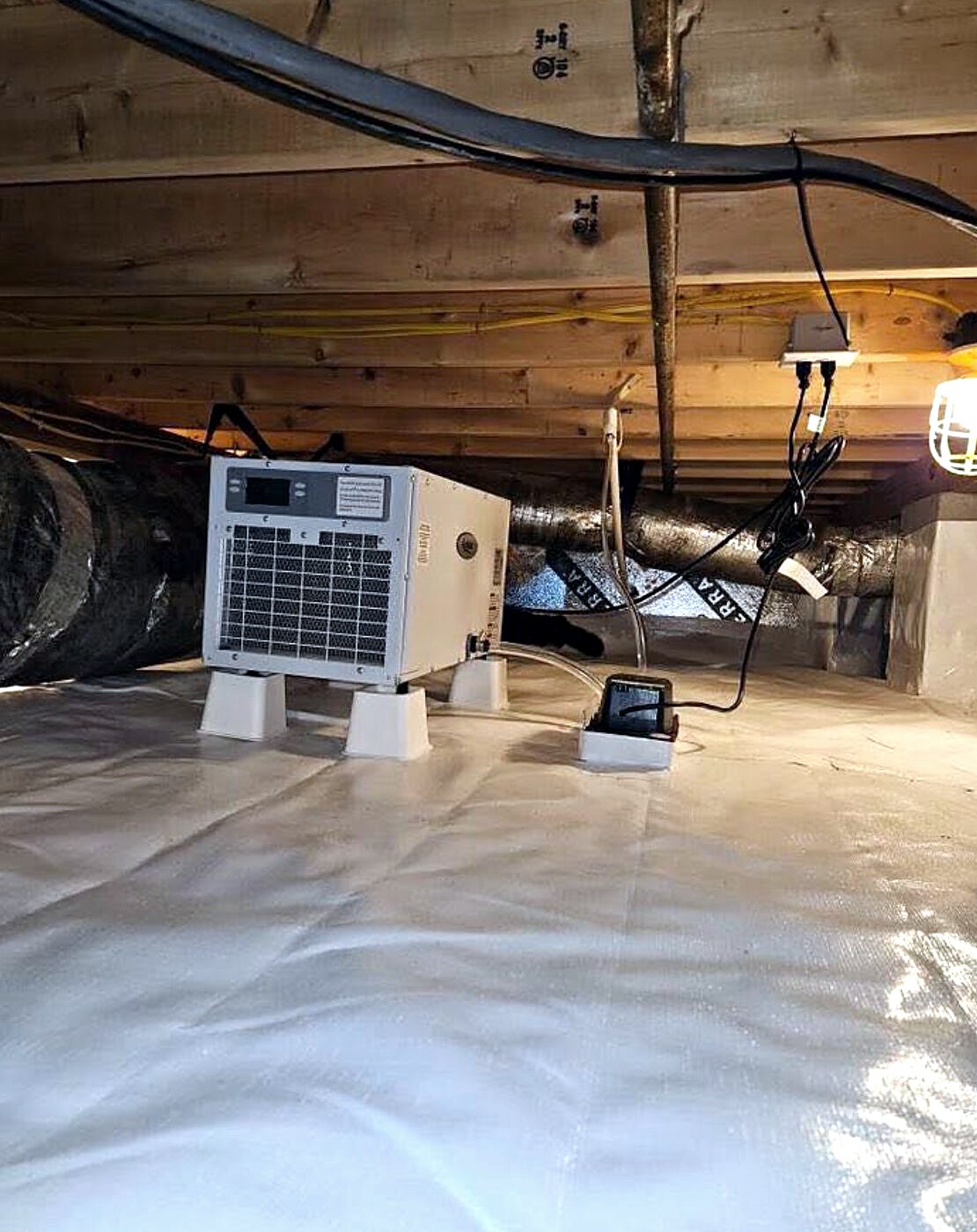
Condensate needs a real discharge path: gravity drain to a suitable point, or a condensate pump with a run that has been thought about. A line that drains onto the liner, or into the soil beside the unit, puts the water straight back into the space the unit just pulled it out of. We have found exactly that under St. Pete houses more than once, and the homeowner had been paying to run the thing for two summers.
The unit is set level, off the ground, on the liner rather than on soil, positioned so air distributes through the space instead of recirculating in one corner, and left accessible. It has a filter. Someone has to reach it.
Electrical: existing GFCI only
This is a firm limit. We install to an existing, code-compliant GFCI receptacle within reach of the unit’s cord. That is the whole of what we do electrically.
We do not run new circuits, add receptacles, extend wiring, or modify a panel. That is licensed electrical work in Florida and we are not licensed for it. If your crawlspace has no suitable receptacle — which is common in Historic Uptown and in any house where nothing has been added under the floor since the original wiring — you need a licensed electrician before we can install. We will tell you that at the evaluation, with a photograph of what is or is not there, so you can get it scheduled rather than finding out on install day.
We also do not use extension cords as a permanent supply, and we will not install a unit that way if asked. Where permit requirements come into a scope, they are set by City of St. Petersburg Construction Services and Permitting and we confirm them for the specific job before work starts.
The same limit applies to everything else we might find down there. We do not do structural repair, foundation repair or mold remediation. If the evaluation turns up failing piers, damaged joists or growth on framing, you get the photographs and a referral to an appropriately licensed contractor.
What this costs
| Range | Average | |
|---|---|---|
| Dehumidifier install, Tampa market | $612–$1,785 | About $1,122 |
| Insulation, for comparison | $765–$2,295 | About $1,428 |
| Vapor barrier only | $1,275–$2,805 | About $2,040 |
| Full encapsulation, unit usually included | $2,300–$12,800 | About $5,100 |
Directional figures from cost aggregators that model regional labor rather than survey local invoices. Florida indexes at about 0.92x the national labor rate and labor is 50 to 70 percent of job cost. The unit itself is a larger share of a dehumidifier job than of most crawlspace work, so the equipment selection moves the number more than the labor does. The evaluation sets the real figure.
Running cost is the question people forget to ask. A correctly sized unit in a sealed space cycles. The same unit in a vented crawlspace runs continuously, all summer, against an unlimited supply of outdoor humidity, and never wins. That is the argument for sealing first.
None of the seven companies bidding this work in St. Petersburg publishes a price. We do, with the caveat attached.
When we tell you not to buy one
If your crawlspace is still vented and has bare soil, a dehumidifier is the wrong purchase. You would be paying to dry the outdoors. Cover the ground, seal the space, and then size a unit for what is left.
If there is standing water, the unit is not the answer either. Kenwood sits close to grade and holds water after heavy summer rain, and Gulfport’s older cottages sit near the waterline over a shallow water table. Water has to have somewhere to go before anything gets plugged in.
And if your space is already sealed, already dry, and reading normal on a meter, we will tell you to keep your money. We tell you when you do not need us. Slab houses and dry crawlspaces get a straight answer and no invoice.
What goes in
- AprilAire E70Dehumidifiers · Up to 70 pints a day · 12.5 × 12.5 × 25 in
- AprilAire E100Dehumidifiers · Up to 100 pints a day · 14 × 15 × 26 in
- Santa Fe Compact70Dehumidifiers · 70 pints a day · Crawlspaces up to 1,800–2,600 sq ft
- Santa Fe Oasis105Dehumidifiers · 105 pints a day · Crawlspaces up to 3,300 sq ft
- ZenAir ZEN-70Dehumidifiers · 70 pints a day at 80°F and 60% humidity · Wi-Fi, phone app
Symptoms this usually explains
Often done alongside
Last reviewed September 2026.