Service
Crawlspace Encapsulation
Sealing the crawlspace under a St. Petersburg bungalow so Gulf humidity stops condensing on the subfloor. What the work involves and what it costs.
Typical range$4,350–$8,050
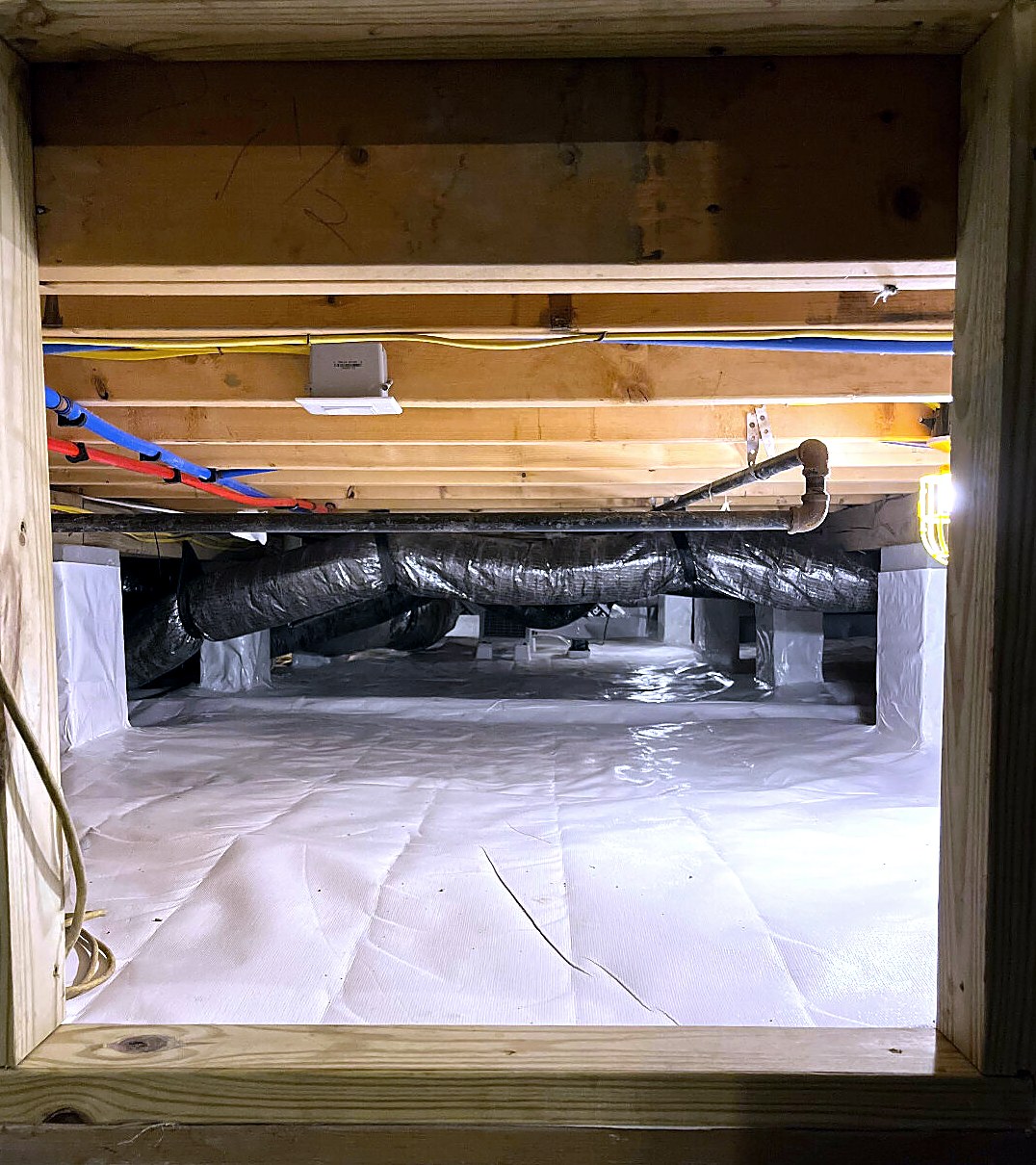
What encapsulation actually is
A reinforced polyethylene liner covers the ground wall to wall. It runs up the perimeter walls and around every pier, gets mechanically fastened, and every seam is lapped and sealed. Penetrations — plumbing stacks, gas lines, the electrical feed — are sealed individually. The foundation vents are closed. Then the humidity in the space is controlled, usually with a crawlspace-rated dehumidifier.
That is the job. The space under your floor stops being outdoors and becomes a buffer between wet ground and dry house. Everything else you will read about encapsulation is either part of making that seal hold or a separate service that pairs with it.
Why this is a St. Petersburg problem and not a Pinellas County problem
St. Petersburg has roughly 20,269 homes built before 1950 — 14.3 percent of the city’s 141,508 housing units. Pinellas County as a whole is only 6.2 percent pre-1950, with a county median year built of 1977. Across the South Atlantic region, 85.7 percent of new single-family homes are built on slabs.
So the raised-foundation house is a St. Pete artifact, and it clusters: Historic Old Northeast, platted 1911 and built out through the 1920s to 1940s; Historic Kenwood, the same era but sitting closer to grade; Historic Uptown, the oldest stock in the city; the pre-1950 half of Crescent Lake; and the 1920s–50s cottages in Gulfport. Drive four blocks the wrong way from any of them and you are in slab country, where none of this applies.
Those bungalows were built to ventilate underneath deliberately. Open the vents, let air move, keep the framing dry. It was sound thinking for the climate people thought they were building for. A century of Gulf humidity turned that design choice into the problem it was meant to prevent: warm, wet outside air enters a vented crawlspace, meets a subfloor kept cool by the air conditioning above it, condenses there, and stays. In July the crawlspace is often the wettest part of the property, and the source is the vents.
Encapsulation is the correction. You stop importing the moisture rather than trying to ventilate your way out of it.
What we find down there
Three things come up on almost every pre-war St. Pete evaluation.
Original cast-iron drain lines, many of them at the end of their service life and being replaced across these neighborhoods right now. If yours is scheduled for replacement, that work happens before encapsulation, not after. We will not seal a liner over a plumber’s coming trench.
Supply and drain lines running through the accessible space. That accessibility is why a slow leak under one of these houses can feed the framing above it for years before anyone notices — nobody goes down there. We photograph every line we pass.
Clearance that ranges from workable to impossible. Kenwood in particular runs tight, and standing water after a heavy summer rain is common there. Some St. Pete bungalows have crawlspaces too tight to enter safely. If yours is one of them we will tell you at the hatch rather than sell you something we cannot properly install.
What goes in
| Component | What we use | Why it matters here |
|---|---|---|
| Ground liner | Reinforced polyethylene, thickness named in your quote | 6-mil builder sheet is not the same product as a 12, 16 or 20-mil reinforced liner. Ask any bidder which one they mean |
| Wall and pier terminations | Mechanically fastened, sealed at the top edge | Unreinforced brick piers are common in Old Northeast and take a different detail than block |
| Seams and penetrations | Lapped and sealed individually | A liner with open seams is a tarp |
| Vents | Closed and sealed | This is the step that stops the moisture import |
| Humidity control | Crawlspace-rated dehumidifier, sized to the space | A sealed space with nothing drying it is a sealed wet space |
| Rim joist | Closed-cell foam or mineral wool | Never fiberglass batts in Florida — see the insulation page |
The liner thickness belongs in writing. It is the single easiest place for a bid to be cheaper than it looks.
Where our work stops
We install liner, insulation and moisture control. We do not do structural repair, foundation repair, or mold remediation. Those need Florida licenses we do not hold, and we will not do licensed work without the license.
In practice that means this: if the evaluation turns up failing piers, cracked or damaged joists, a sagging girder or a rotted sill, you get the photographs, a written description of what we saw and where, and a referral to a contractor licensed for that work. We do not encapsulate over structural damage and call the job finished. Sealing a crawlspace does not repair anything — it removes the moisture that caused the damage, which is worth doing, but only after the damage itself is addressed by someone allowed to address it.
What this costs
Full encapsulation in the Tampa market runs $2,300 to $12,800 with an average near $5,100. For a 1,500 square foot St. Pete crawlspace the average lands around $5,850, with a typical range of $4,350 to $8,050.
| Range | Notes | |
|---|---|---|
| Full encapsulation, Tampa market | $2,300–$12,800 | Average about $5,100 |
| 1,500 sq ft St. Pete crawlspace | $4,350–$8,050 | Average about $5,850 |
| National installed rate | $3–$10 per sq ft | Wide because scope varies enormously |
Those are directional figures from cost aggregators that model labor by region rather than survey local invoices. Florida indexes at about 0.92x the national labor rate, and labor is 50 to 70 percent of what you pay on a job like this, so the modeled numbers are in the right neighborhood — they are not a quote. Clearance, debris load, standing water, pier count, liner thickness and whether the plumbing is about to be replaced all move the real number. The evaluation sets it.
We publish these ranges because none of the companies you are also calling do. That is a choice on their part, and you can decide what it means.
How the job runs
An evaluation first: measurements, clearance, moisture readings, photographs of the piers, the framing, the ducts and the lines. You get the photographs whether or not you hire us.
If we quote, the quote names the liner product and thickness, the square footage, the dehumidifier model if one is included, and what is excluded. Where permits come into it, requirements are set by City of St. Petersburg Construction Services and Permitting, and we confirm them for your specific scope before work starts rather than assuming.
Cleanout comes before liner. Debris, old fallen insulation and any standing water are handled first; a liner installed over a mess is a liner that gets cut open later.
When we tell you not to do this
If you have a slab, there is nothing to encapsulate and no reason to pay anyone to tell you otherwise. Crescent Lake is split roughly along 1950, and we answer that question at the curb for free.
If your crawlspace is dry, well drained, has an intact barrier and reads normal on a moisture meter, we will say so. We tell you when you do not need us. Slab houses and dry crawlspaces get a straight answer and no invoice.
And if the real problem is drainage — water entering from outside rather than vapor coming up from the ground — encapsulation alone will not fix it. Drainage work in this market runs $1,275 to $3,570 and comes first. A liner is not a substitute for getting water away from the house.
What goes in
- ProSeal 12 mil woven linerGround liners · 12 mil · Woven, fully reinforced
- ProSeal 16 mil woven linerGround liners · 16 mil · Woven, fully reinforced
- ProSeal 20 mil woven linerGround liners · 20 mil · Woven, fully reinforced
- WFP 20 mil hybrid linerGround liners · 20 mil · String and woven hybrid
- ProSeal 12 mil woven wall linerWall liner, seams and drain mat · 12 mil · Woven, fully reinforced
- WFP Pro Tape seam tapeWall liner, seams and drain mat · 9 mil · 4 in
- Your Crawl Space Pro Drain MatWall liner, seams and drain mat · Coated top, felt bottom · Under the liner
- AprilAire E70Dehumidifiers · Up to 70 pints a day · 12.5 × 12.5 × 25 in
- AprilAire E100Dehumidifiers · Up to 100 pints a day · 14 × 15 × 26 in
- Santa Fe Compact70Dehumidifiers · 70 pints a day · Crawlspaces up to 1,800–2,600 sq ft
- Santa Fe Oasis105Dehumidifiers · 105 pints a day · Crawlspaces up to 3,300 sq ft
- ZenAir ZEN-70Dehumidifiers · 70 pints a day at 80°F and 60% humidity · Wi-Fi, phone app
- Terma-Foam Graphite FR foam boardInsulation · R-10 (2 in) · Graphite polystyrene, fire rated
- DAP Touch ’n Seal Closed-cell spray foamInsulation · R-6.6 per inch · ASTM E-84 Class A
- WFP Crawlspace access doorDoors and vents · UV-stabilized ABS · 16 × 24, 16 × 32, 20 × 32 in
- WFP Recessed vent coverDoors and vents · Standard 8 × 16 in foundation vent · ABS
- Terma-Foam Vent blockDoors and vents · 8 × 16 × 1 in · R-2
- Flood Flaps Multi Flow flood ventDoors and vents · ICC-ES · 220 sq ft per vent (maker’s figure)
Symptoms this usually explains
- Musty smell that will not leaveThe smell returns every August no matter how much you clean. In a pre-war St. Pete bungalow it is often coming from under the floor, not from anything in the room.
- Cupped floors, sweating ducts, high cooling billsThree symptoms that look unrelated until you go under the house: floorboards cupping at the edges, ducts dripping, and summer power bills that do not match the square footage.
Often done alongside
- Vapor Barrier InstallationReinforced liner over bare crawlspace soil — the cheaper first move when the ground is the moisture source and the vents are not.
- Crawlspace DehumidifierA crawlspace-rated unit sized to your space, set on the liner with a real condensate path and an existing GFCI receptacle.
- Crawlspace InsulationClosed-cell foam or mineral wool at the rim joist, because fiberglass batts in a Florida crawlspace end up wet on the ground.
Last reviewed September 2026.